




Height rank
Willis Tower
Chicago




stevenhenry.jpg)


- Facts
-
Metrics
You must be a CVU Member to view this resource.
Official Name
Willis Tower
Other Names
Sears Tower
Type
Building
Status
Completed
Completion
1974
Country
City
Address
Function
A mixed-use tall building contains two or more functions (or uses), where each of the functions occupy a significant proportion of the tower's total space. Support areas such as car parks and mechanical plant space do not constitute mixed-use functions. Functions are denoted on CVU "Tallest Building" lists in descending order, e.g., "hotel/office" indicates hotel function above office function.
Office
Structural Material
Both the main vertical/lateral structural elements and the floor spanning systems are constructed from steel. Note that a building of steel construction with a floor system of concrete planks or concrete slab on top of steel beams is still considered an “all-steel” structure as the concrete elements are not acting as the primary structure.
All-Concrete
Both the main vertical/lateral structural elements and the floor spanning systems are constructed from concrete which has been cast in place and utilizes steel reinforcement bars and/or steel reinforced concrete which has been precast as individual components and assembled together on-site.
All-Timber
Both the main vertical/lateral structural elements and the floor spanning systems are constructed from timber. An all-timber structure may include the use of localized non-timber connections between timber elements. Note that a building of timber construction with a floor system of concrete planks or concrete slab on top of timber beams is still considered an “all-timber” structure as the concrete elements are not acting as the primary structure.
Mixed-Structure
Utilizes distinct systems (e.g. all-steel, all-concrete, all-timber), one on top of the other. For example, a Steel Over Concrete indicates an all-steel structural system located on top of an all-concrete structural system, with the opposite true of Concrete Over Steel.
Composite
A combination of materials (e.g. steel, concrete, timber) are used together in the main structural elements. Examples include buildings which utilize: steel columns with a floor system of reinforced concrete beams; a steel frame system with a concrete core; concrete-encased steel columns; concrete-filled steel tubes; etc. Where known, the CVU database breaks out the materials used within a composite building’s primary structural elements.
All-Steel
Energy Label
LEED Recertification Platinum (2019), LEED Gold O+M: Existing Buildings (2016)
Official Website
Height
442.1 m / 1,451 ft
Floors Above Ground
108
Floors Below Ground
3
# of Elevators
104
Top Elevator Speed
8.1 m/s
Tower GFA
423,638 m² / 4,560,001 ft²
Rankings
-
By function
You must be a CVU Member to view this resource.
-
By material
You must be a CVU Member to view this resource.
Construction Schedule
Construction Start
Completed
Retrofit Start
Retrofit End
Architect
Usually involved in the front end design, with a "typical" condition being that of a leadership role through either Schematic Design or Design Development, and then a monitoring role through the CD and CA phases.
Structural Engineer
The Design Engineer is usually involved in the front end design, typically taking the leadership role in the Schematic Design and Design Development, and then a monitoring role through the CD and CA phases.
MEP Engineer
The Design Engineer is usually involved in the front end design, typically taking the leadership role in the Schematic Design and Design Development, and then a monitoring role through the CD and CA phases.
Other Consultant
Other Consultant refers to other organizations which provided significant consultation services for a building project (e.g. wind consultants, environmental consultants, fire and life safety consultants, etc).
Other Consultant refers to other organizations which provided significant consultation services for a building project (e.g. wind consultants, environmental consultants, fire and life safety consultants, etc).
These are firms that consult on the design of a building's façade. May often be referred to as "Cladding," "Envelope," "Exterior Wall," or "Curtain Wall" Consultant, however, for consistency CTBUH uses the term "Façade Consultant" exclusively.
Material Supplier
Material Supplier refers to organizations which supplied significant systems/materials for a building project (e.g. elevator suppliers, facade suppliers, etc).
Material Supplier refers to organizations which supplied significant systems/materials for a building project (e.g. elevator suppliers, facade suppliers, etc).
Retrofit Companies Involved
Architect
Usually involved in the front end design, with a "typical" condition being that of a leadership role through either Schematic Design or Design Development, and then a monitoring role through the CD and CA phases.
Structural Engineer
The Design Engineer is usually involved in the front end design, typically taking the leadership role in the Schematic Design and Design Development, and then a monitoring role through the CD and CA phases.
MEP Engineer
The Engineer of Record takes the balance of the engineering effort not executed by the “Design Engineer,” typically responsible for construction documents, conforming to local codes, etc.
Contractor
The main contractor is the supervisory contractor of all construction work on a project, management of sub-contractors and vendors, etc. May be referred to as "Construction Manager," however, for consistency CTBUH uses the term "Main Contractor" exclusively.
Other Consultant
Other Consultant refers to other organizations which provided significant consultation services for a building project (e.g. wind consultants, environmental consultants, fire and life safety consultants, etc).
Other Consultant refers to other organizations which provided significant consultation services for a building project (e.g. wind consultants, environmental consultants, fire and life safety consultants, etc).
Material Supplier
Material Supplier refers to organizations which supplied significant systems/materials for a building project (e.g. elevator suppliers, facade suppliers, etc).
Material Supplier refers to organizations which supplied significant systems/materials for a building project (e.g. elevator suppliers, facade suppliers, etc).
You must be a CVU Member to view this resource.
Owner
The Blackstone Group L.P.
The Moinian Group
Developer
Sears Roebuck and Company
Occupier/Tenant
Abbott; Adtalem Global Education; ArentFox Schiff; IMC Financial Markets; United Airlines, Inc.; Zurich Insurance Group
Architect
Usually involved in the front end design, with a "typical" condition being that of a leadership role through either Schematic Design or Design Development, and then a monitoring role through the CD and CA phases.
Structural Engineer
The Design Engineer is usually involved in the front end design, typically taking the leadership role in the Schematic Design and Design Development, and then a monitoring role through the CD and CA phases.
MEP Engineer
The Design Engineer is usually involved in the front end design, typically taking the leadership role in the Schematic Design and Design Development, and then a monitoring role through the CD and CA phases.
Contractor
The main contractor is the supervisory contractor of all construction work on a project, management of sub-contractors and vendors, etc. May be referred to as "Construction Manager," however, for consistency CTBUH uses the term "Main Contractor" exclusively.
Morse Diesel International
Other Consultant
Other Consultant refers to other organizations which provided significant consultation services for a building project (e.g. wind consultants, environmental consultants, fire and life safety consultants, etc).
Other Consultant refers to other organizations which provided significant consultation services for a building project (e.g. wind consultants, environmental consultants, fire and life safety consultants, etc).
These are firms that consult on the design of a building's façade. May often be referred to as "Cladding," "Envelope," "Exterior Wall," or "Curtain Wall" Consultant, however, for consistency CTBUH uses the term "Façade Consultant" exclusively.
EQ Office; Telos Group
Material Supplier
Material Supplier refers to organizations which supplied significant systems/materials for a building project (e.g. elevator suppliers, facade suppliers, etc).
Material Supplier refers to organizations which supplied significant systems/materials for a building project (e.g. elevator suppliers, facade suppliers, etc).
American Bridge Company
Retrofit Companies Involved
Owner/Developer
The Blackstone Group L.P.
Architect
Usually involved in the front end design, with a "typical" condition being that of a leadership role through either Schematic Design or Design Development, and then a monitoring role through the CD and CA phases.
Structural Engineer
The Design Engineer is usually involved in the front end design, typically taking the leadership role in the Schematic Design and Design Development, and then a monitoring role through the CD and CA phases.
MEP Engineer
The Engineer of Record takes the balance of the engineering effort not executed by the “Design Engineer,” typically responsible for construction documents, conforming to local codes, etc.
Project Manager
The CTBUH lists a project manager when a specific firm has been commissioned to oversee this aspect of a tall building’s design/construction. When the project management efforts are handled by the developer, main contract, or architect, this field will be omitted.
The CTBUH lists a project manager when a specific firm has been commissioned to oversee this aspect of a tall building’s design/construction. When the project management efforts are handled by the developer, main contract, or architect, this field will be omitted.
EQ Office
Contractor
The main contractor is the supervisory contractor of all construction work on a project, management of sub-contractors and vendors, etc. May be referred to as "Construction Manager," however, for consistency CTBUH uses the term "Main Contractor" exclusively.
Clayco; Turner Construction Company
Clark Construction Group
Other Consultant
Other Consultant refers to other organizations which provided significant consultation services for a building project (e.g. wind consultants, environmental consultants, fire and life safety consultants, etc).
Other Consultant refers to other organizations which provided significant consultation services for a building project (e.g. wind consultants, environmental consultants, fire and life safety consultants, etc).
Studio Olafur Eliasson
Rivion
Chicago Scenic Studios, Inc.; Skidmore, Owings & Merrill LLP; Thinc Design
Material Supplier
Material Supplier refers to organizations which supplied significant systems/materials for a building project (e.g. elevator suppliers, facade suppliers, etc).
Material Supplier refers to organizations which supplied significant systems/materials for a building project (e.g. elevator suppliers, facade suppliers, etc).
Global News

26 September 2023
New Antenna Installed Atop Willis Tower
ABC7 Chicago successfully installed a brand new antenna on the Willis Tower on a Sunday morning. The process was captured by Chopper 7. A helicopter...
About Willis Tower
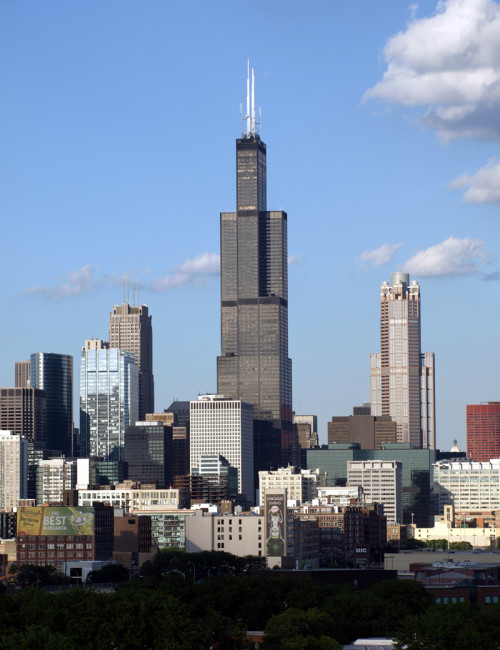
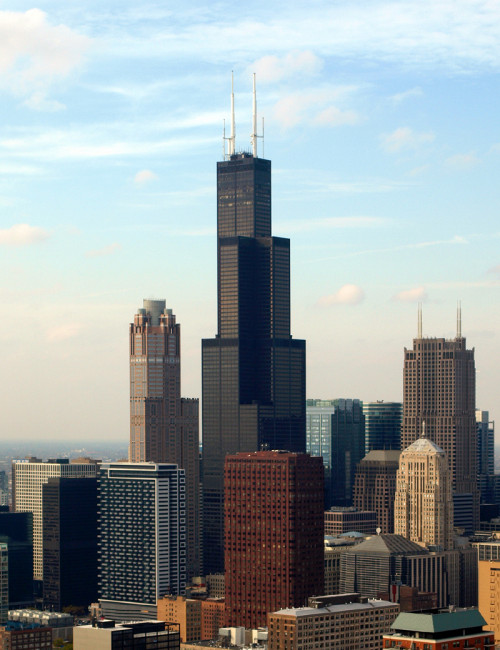
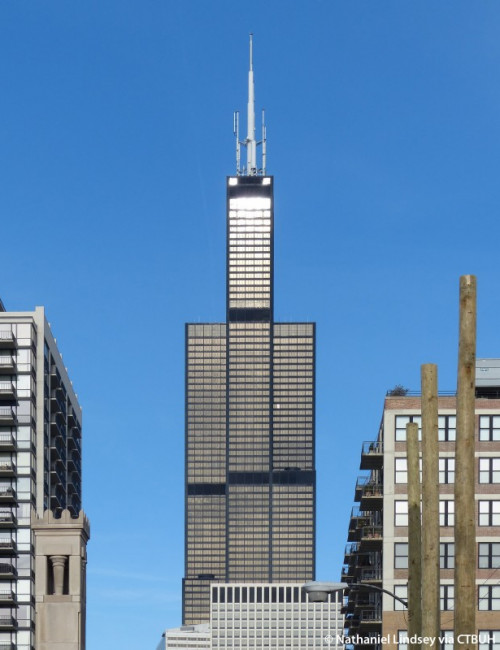
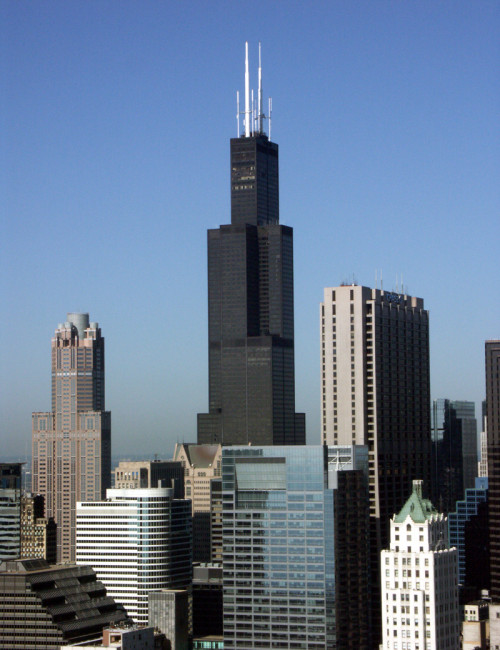
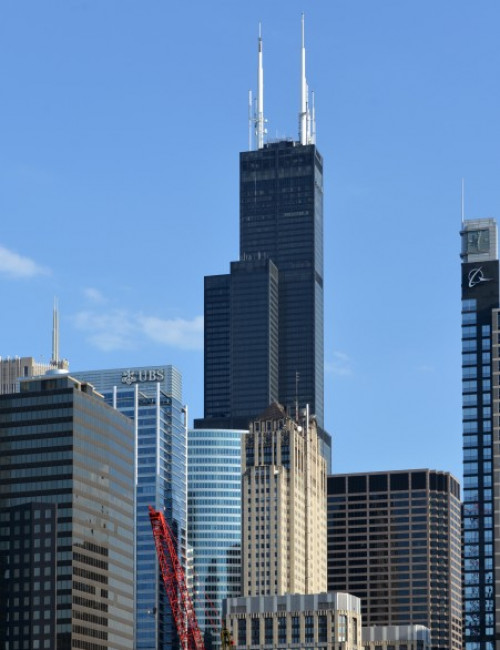
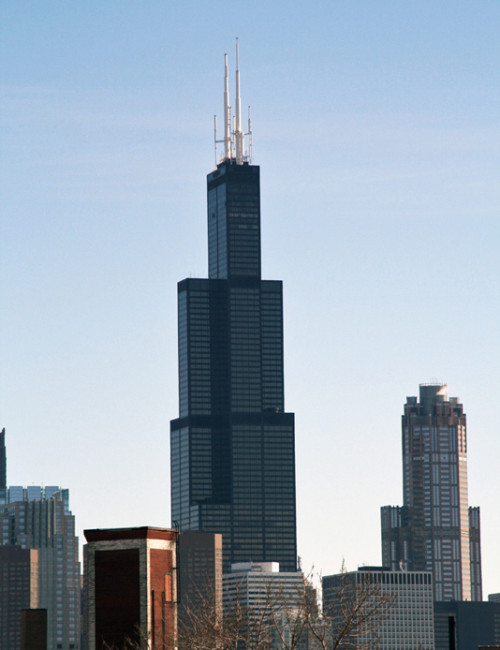
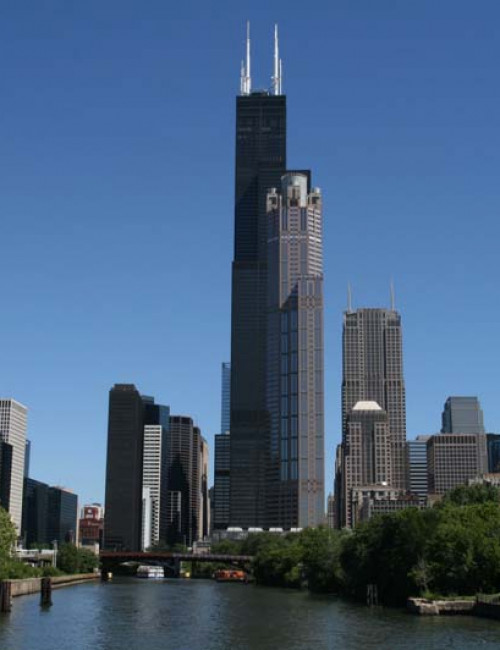
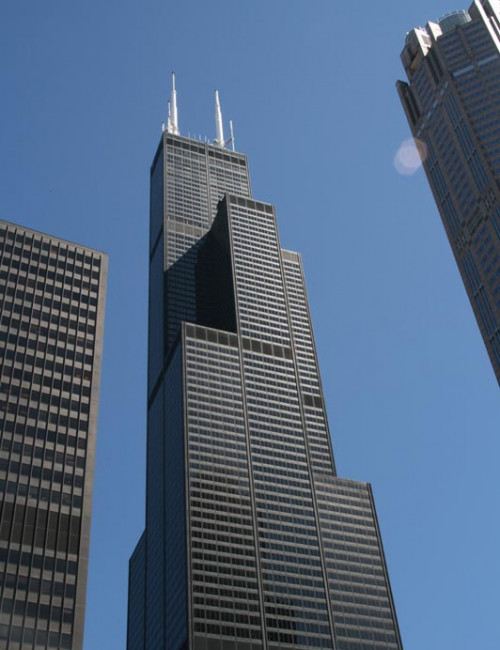
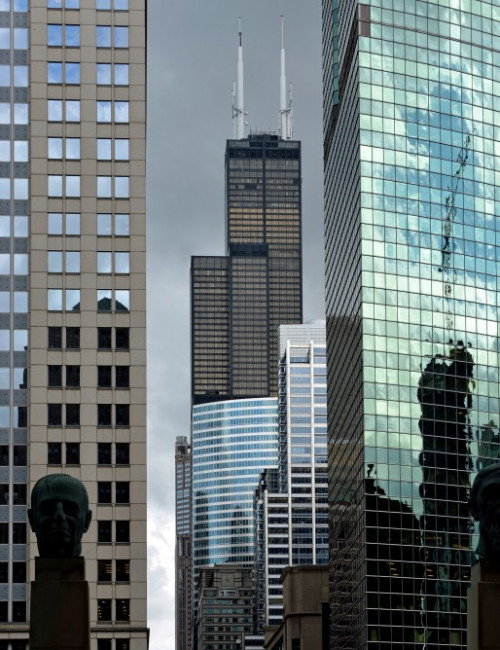
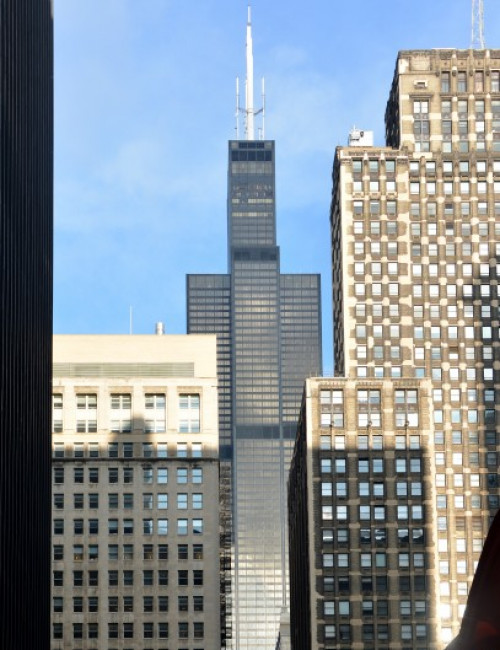
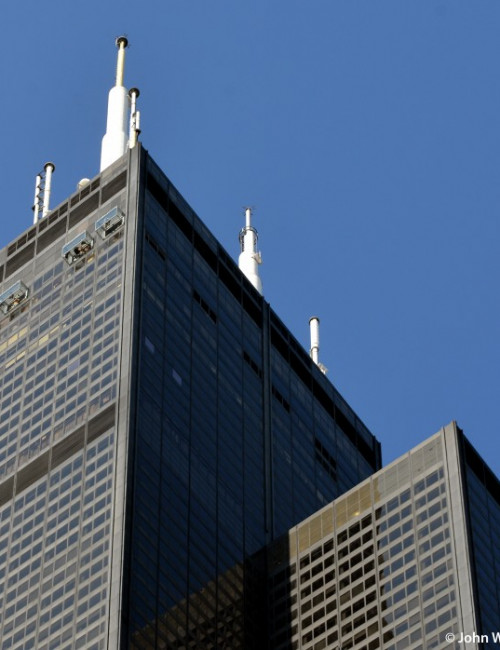
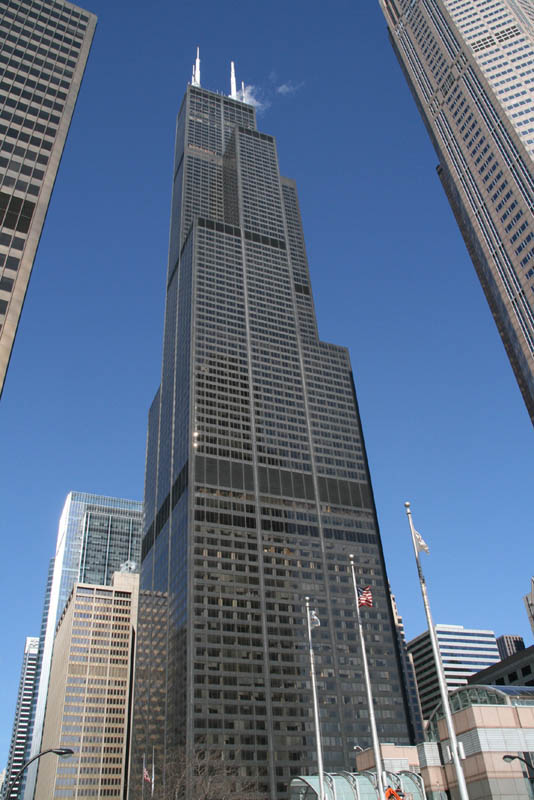
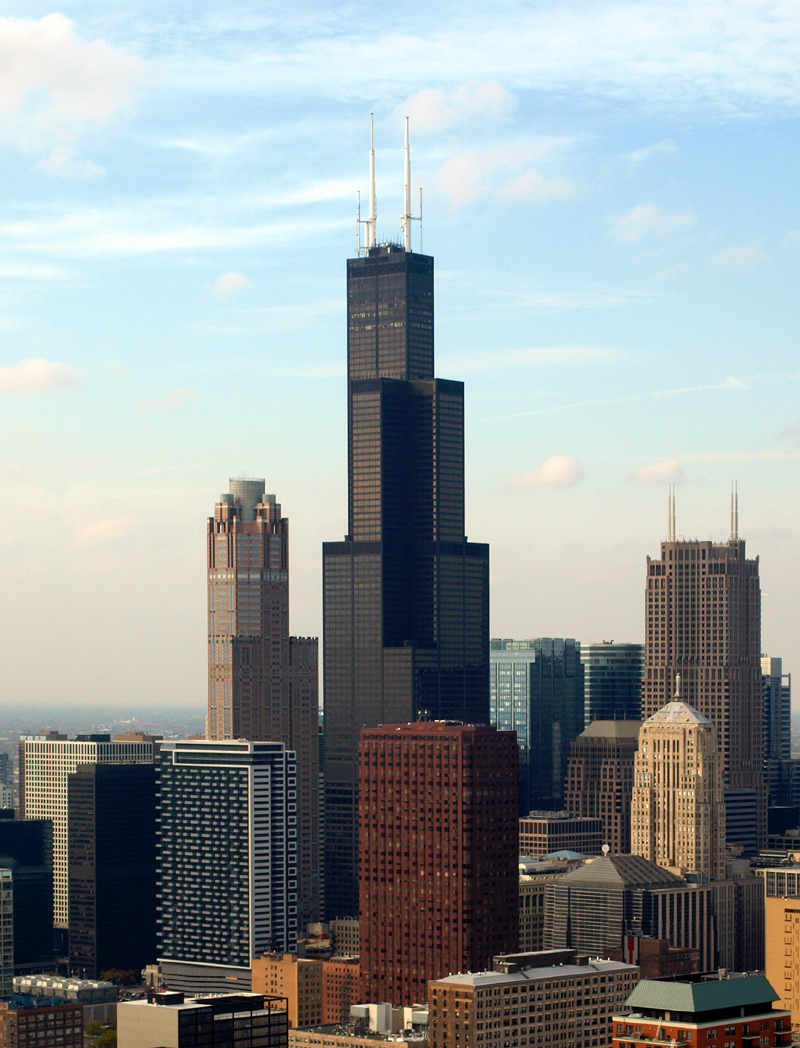
The Willis Tower (formerly Sears Tower) in Chicago, with its signature black aluminum and bronze-tinted glare-reducing glass, was the tallest building in the world for nearly 25 years. Completed in 1974, Willis Tower set the standard for supertall skyscrapers around the globe, both in its innovative design and graceful styling. With approximately 424,000 square meters of gross floor area, the building is comparatively large for its height, with its foundation and the first 50 floors taking up an entire city block before the building begins to narrow.
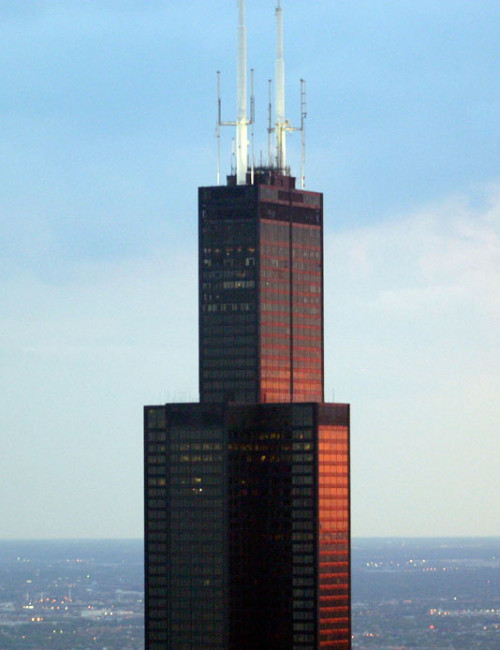
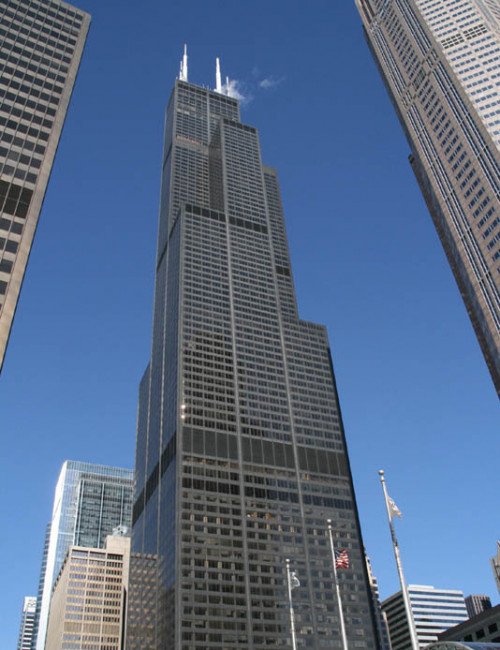
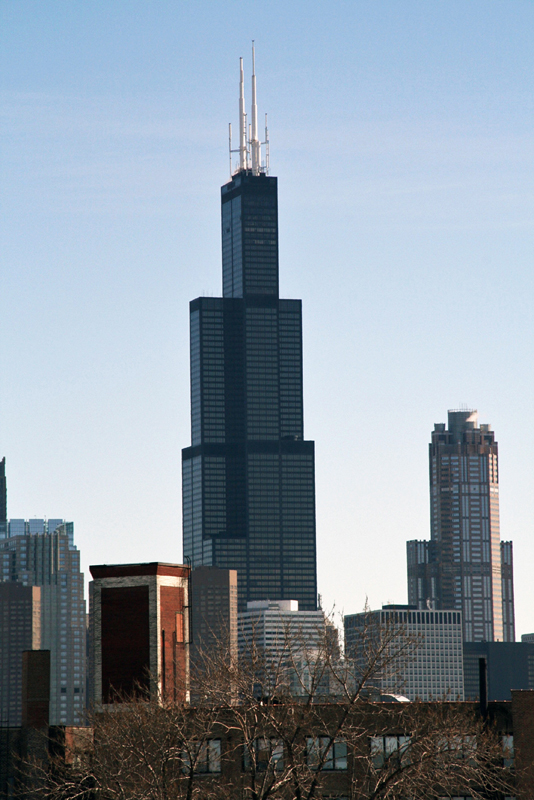
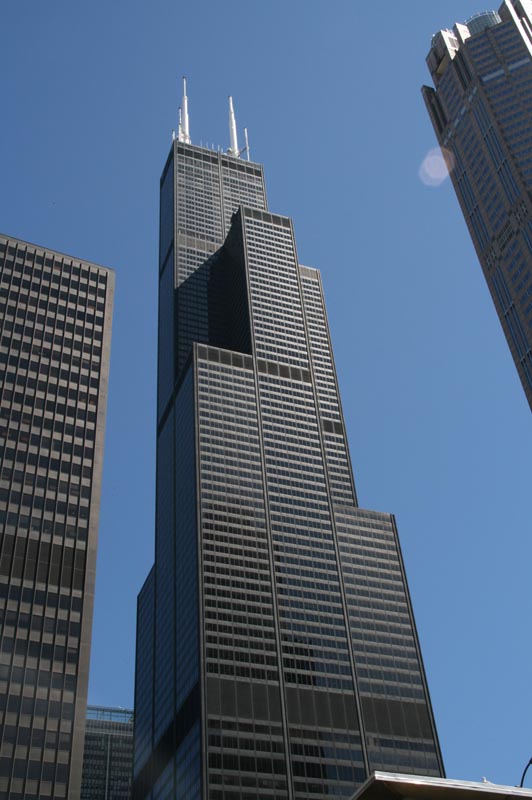
The step-back design of the structure was designed by the architects as a direct result of Sears’ space requirements. The designers were required to develop a building that incorporated not only very large office floors, which were necessary to Sears’ operation, but also a variety of smaller floors which would be more suitable for tenants requiring less floor area. These requirements resulted in a bundled tube structure, the first of its kind. This innovative design was not only structurally efficient, but it also managed to be economical as well. It has proven to be a remarkably influential design typology, and has been used in most supertall buildings built since the Willis Tower, including the Burj Khalifa.
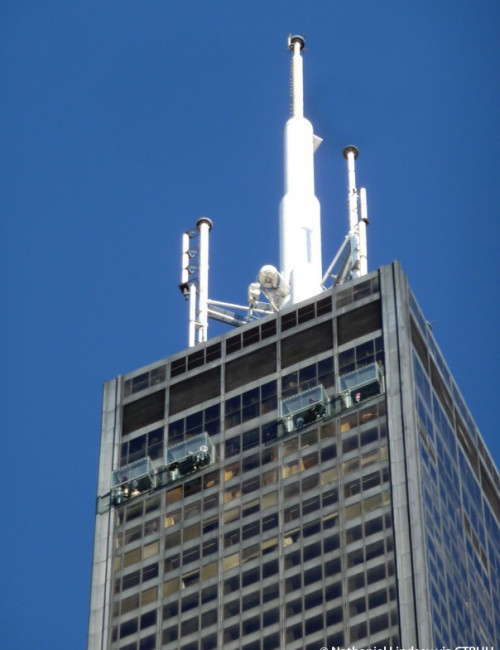
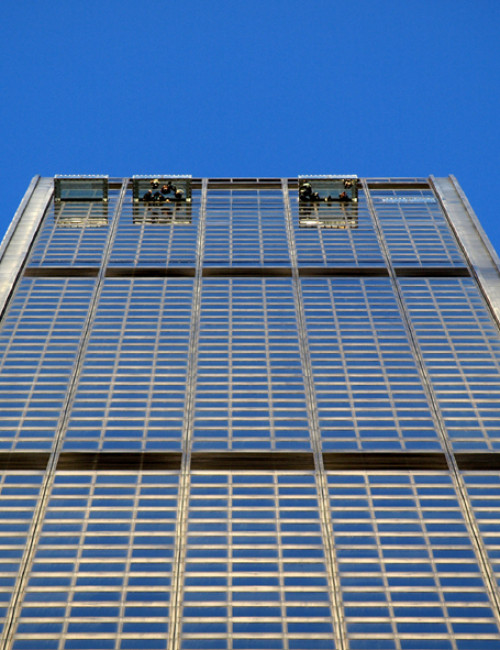
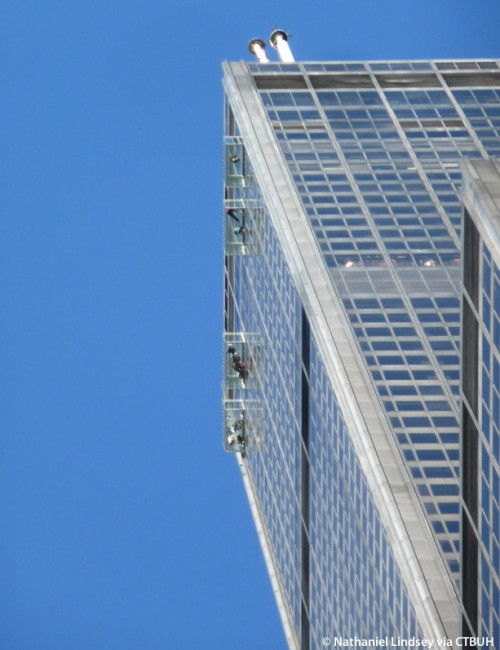
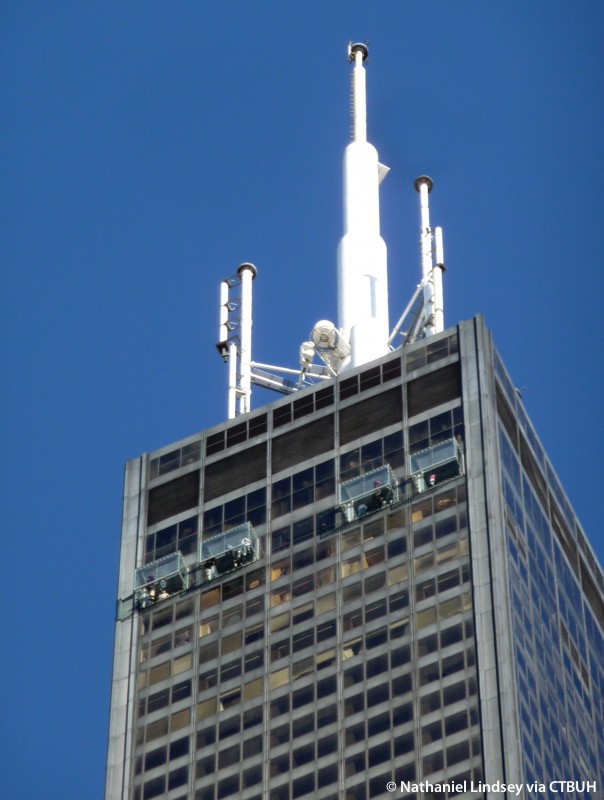
An assortment of features has kept the tower active, inviting, and efficient over its operational life. An undulating Alexander Calder sculpture greets office workers in the west lobby. Meanwhile, a 2009 addition to the observation deck affords visitors with vertigo-inducing views of Chicago via “The Ledge,” a series of boxes with transparent floors that extrude from the top of the building. Although the Willis Tower was built in an age before sustainable design matured, the building’s owners have recently implemented several sustainable elements, including low-flow fixtures that conserve more than 38 million liters of water annually, and high-efficiency lighting systems that help curb electrical loads.
Quick Facts
- Tallest building in the world 1974 - 1998. Preceded by One World Trade Center and surpassed by the Petronas Tower 1
Global News
26 September 2023
New Antenna Installed Atop Willis Tower
ABC7 Chicago successfully installed a brand new antenna on the Willis Tower on a Sunday morning. The process was captured by Chopper 7. A helicopter...

22 June 2022
Laboratory Company Opening Office in Chicago's Tallest Building
Abbott Laboratories is opening a big new office at Willis Tower that could bring as many as 450 jobs downtown, a move meant to provide...

08 July 2021
Insurance Company Sues City of Chicago After Skyscraper Floods
The insurer for the Willis Tower in Chicago is suing the City of Chicago in an attempt to recoup some of its costs in paying...

23 April 2021
Skydeck at Chicago's Tallest Building Reopens Featuring a New Interactive Museum
EQ Office announced the exciting reopening of Skydeck Chicago at Willis Tower to the public on 23 April, 2021 after completing an extensive redevelopment. The...

03 February 2021
Airline Reduces Chicago Tower Footprint After Sweeping COVID-19-Related Cuts
United Airlines is shrinking its Willis Tower headquarters, where it has about 30 percent fewer workers than before the COVID-19 pandemic. The airline today confirmed...

12 January 2021
New Art Installation Revealed at Chicago's Tallest Tower
EQ Office revealed Atmospheric wave wall, a new cultural landmark and the first public art installation in Chicago by globally acclaimed artist Olafur Eliasson. Prominently...

13 October 2020
Iconic Chicago Tower Bets on the Future of Co-Working
Reports of the demise of co-working during the pandemic are greatly exaggerated, if you ask the owner of Willis Tower. In a bet on the...

25 September 2020
New Partnership Brings Renewable Energy to Chicago Landmark Tower
Dynegy today announced that it has entered into a multi-year partnership with Chicago's iconic Willis Tower to provide 100% renewable electricity to the Tower. "Sustainability...

18 July 2019
Transformation of Chicago’s Willis Tower Begins with New Art-Filled Lobby
EQ Office, the US office portfolio company owned by Blackstone, has reopened Willis Tower’s Wacker Drive lobby, featuring a new, one-of-a-kind art installation created by...

15 April 2019
New Architects Brought in for Manchester’s St. Michael’s Tower
Skidmore, Owings & Merrill (SOM) has been brought in to deliver Hodder + Partners’ controversial Saint Michael’s tower in Manchester, with the local practice kept...
Learn more about the Council on Vertical Urbanism
Discover how vertical living is shaping the next generation of urban environments. Explore insights, research, and global leadership in vertical urban development